
A Balanced Bite Protects Your Teeth, Jaw and Smile
A crossbite happens when some upper teeth sit inside the lower teeth instead of slightly outside them. This can wear enamel, strain the jaw and push facial growth off balance over time. At Schmidl Orthodontics, we correct crossbites for children, teens and adults from our Medford and Ashland, OR offices. We use options that match your age and bite, from gentle palatal expansion to braces and clear aligners.
Request an AppointmentWhat Is a Crossbite?
In a healthy bite, the upper teeth close slightly outside the lower teeth all the way around the arch. With a crossbite, one or more upper teeth close behind or inside the lower teeth. A crossbite is one of the common teeth and bite problems we see in children and adults across the Rogue Valley. It rarely corrects itself without orthodontic care.
Types of Crossbite
- Posterior crossbite: The upper back teeth sit inside the lower back teeth. It can affect one side (unilateral) or both sides (bilateral).
- Anterior crossbite: One or more upper front teeth sit behind the lower front teeth. A full anterior crossbite is often linked to an underbite.
- Single-tooth crossbite: One tooth erupts out of line and gets caught behind the opposing arch.
- Skeletal vs. dental crossbite: A skeletal crossbite comes from jaw size or position. A dental crossbite comes from tooth position alone.
What Causes a Crossbite?
The most common cause of a posterior crossbite is a narrow upper jaw. Other causes include:
- Inherited jaw size and shape
- Long-term thumb sucking, finger sucking or pacifier use
- Chronic mouth breathing, which can keep the tongue low and limit upper jaw growth
- Baby teeth that fall out early or stay in too long, which pushes adult teeth off course
- Crowding that forces a permanent tooth to erupt out of position
Why Crossbites Should Be Treated
A crossbite is more than a cosmetic concern. If you don’t treat it, a crossbite can lead to:
- Uneven wear, chipping or cracking of the enamel on the teeth caught in the bite
- Gum recession around lower front teeth pushed forward by an anterior crossbite
- A sideways shift of the lower jaw when biting, which can cause uneven jaw growth and facial asymmetry in growing children
- Jaw muscle fatigue, clicking or discomfort in the jaw joint
- Difficulty chewing efficiently on one or both sides
Signs Your Child or You May Have a Crossbite
Look for upper teeth that close behind the lower teeth, a lower jaw that slides to one side as the teeth come together, or a chin that looks off-center. Uneven tooth wear can also be a sign. Because many crossbites start in childhood, the American Association of Orthodontists recommends a first orthodontic check by age 7. An early treatment evaluation lets us spot a crossbite while the jaw is still growing and easier to guide.
How We Treat Crossbites at Every Age
Treatment depends on whether the crossbite is skeletal or dental, which teeth are involved and how much growth remains.
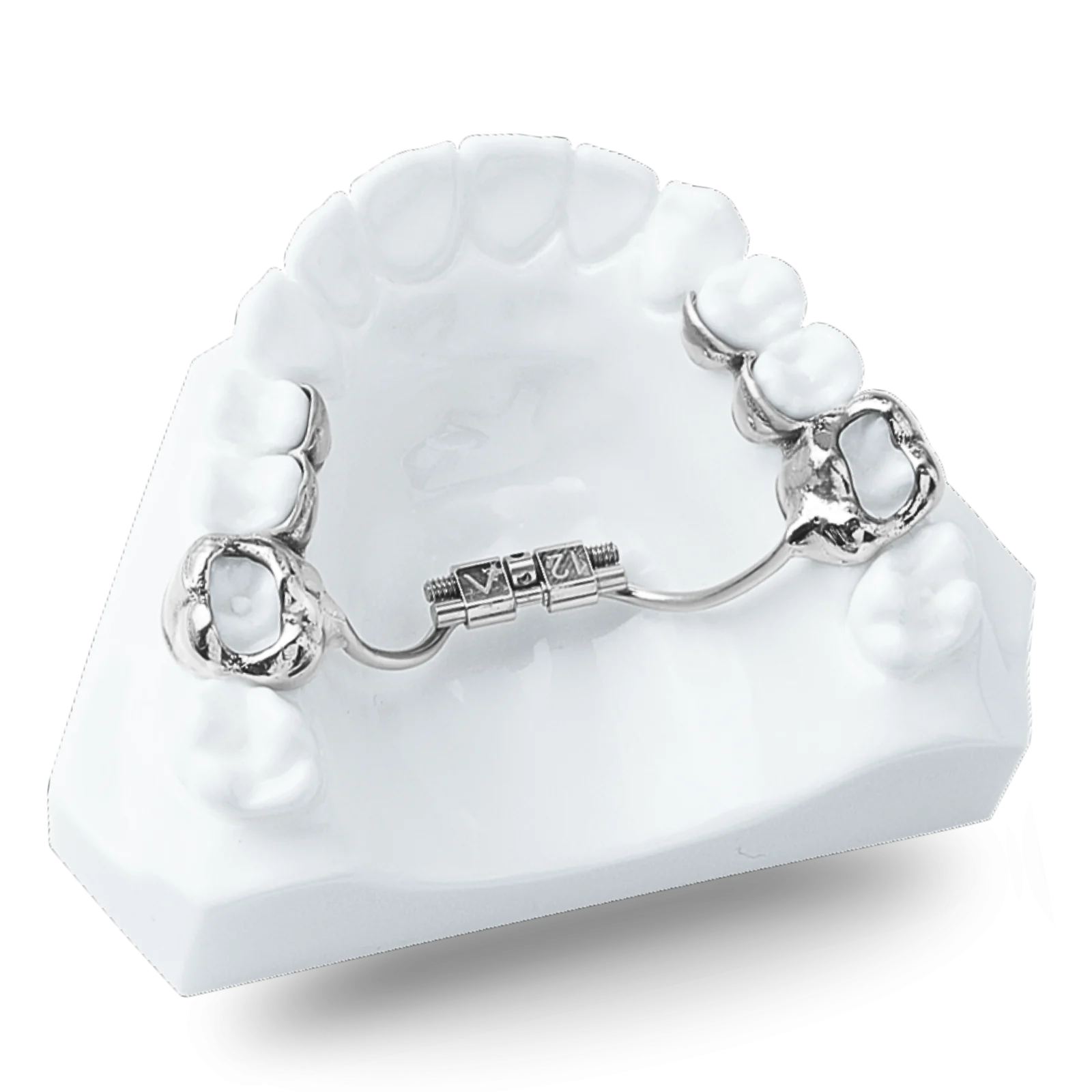
- Children: A Rapid Palatal Expander (RPE) gently widens the upper jaw along its natural growth seam. This often corrects a posterior crossbite in a few months and creates room for adult teeth.
- Teens: Adolescent treatment often pairs expansion with braces, including KLOwen custom braces, plus elastics to move individual teeth into proper position.
- Adults: Once the growth seam has fused, we may recommend palatal expansion in non-growers using mini-implant-assisted expanders. In more complex cases, we may recommend Surgically Facilitated Orthodontic Therapy (SFOT). Learn more about adult treatment.
- Dental crossbites: When only one or two teeth are out of line, clear aligners or braces can often tip them into place without expansion.
Many patients can also check in between visits with Dental Monitoring, which uses smartphone scans to track progress. After correction, a custom retainer holds the new width and bite in place.
Crossbite, Breathing and Sleep
A narrow upper jaw that causes a crossbite often goes along with a narrow nasal airway. Widening the upper jaw can make it easier to breathe through the nose. That’s why we look at crossbites as part of our airway orthodontics approach whenever snoring or mouth breathing is also present.
Personalized Care From a Specialist
Dr. Dana Schmidl reviews digital records with you to explain exactly what type of crossbite is present and why. She will walk you through each option and its timeline. Curious about specialist training? Learn what a board certified orthodontist is. You can also browse our smile gallery to see real results.
Crossbite Questions From Medford & Ashland Families
Can a crossbite fix itself as my child grows?
Very rarely. Most crossbites, especially those caused by a narrow upper jaw, stay the same or get worse with growth. A sideways jaw shift can also lead to uneven jaw development. Early evaluation gives us the best chance to correct the problem simply.
What age is best to treat a crossbite?
Skeletal posterior crossbites are easiest to correct while the upper jaw’s growth seam is still open, usually before the teen years. We recommend a first visit by age 7. Teens and adults can still be treated with braces, clear aligners, mini-implant-assisted expansion or SFOT.
Does a palatal expander hurt?
Most children feel mild pressure in the teeth, cheeks or nose for a few minutes after each turn. A small gap may appear between the front teeth during expansion. This is normal and closes later in treatment.
Can clear aligners fix a crossbite?
Clear aligners can correct many dental crossbites, where only a few teeth are out of position. Skeletal crossbites caused by a narrow jaw usually need expansion first. Aligners may then be used to finish the bite.
How long does crossbite treatment take?
Expansion with an RPE often takes a few weeks of activation, then several months of stabilization. Comprehensive treatment with braces or aligners typically lasts 12 to 24 months, depending on the complexity of the bite.
Can adults correct a crossbite without jaw surgery?
Many adults can. Mini-implant-assisted palatal expansion widens the upper jaw in non-growing patients without traditional jaw surgery. Dental crossbites often respond well to braces or aligners. Some severe skeletal cases may still need a surgical approach, which we’ll discuss openly.
Will the crossbite come back after treatment?
Wearing your retainer as directed is the best way to keep your results. After expansion, we hold the new width in place long enough for bone to stabilize. Then we give you a custom retainer for long-term retention.
Get Your Bite Back in Balance
Whether you’ve noticed your child’s jaw shifting or you’ve lived with a crossbite for years, we can help you understand your options. Schedule an exam with Schmidl Orthodontics at our Medford office at (541) 773-6600 or our Ashland office at (541) 482-4343.