
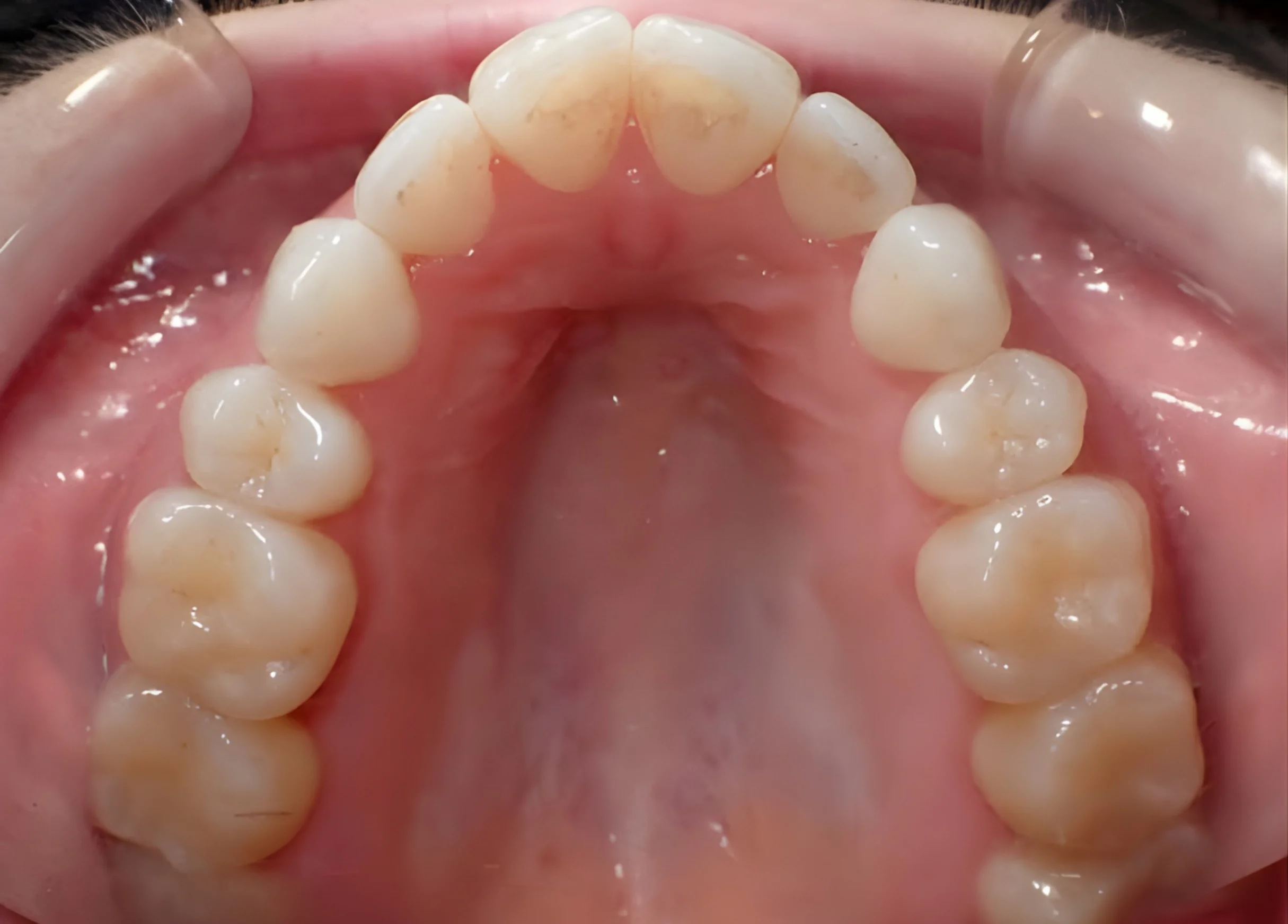
More Room for Teeth, Easier Breathing and a Balanced Bite
A narrow upper jaw affects more than the look of a smile. When the palate is too small, teeth crowd together, the bite can shift into a crossbite, and the nasal airway above the palate may be narrower than it should be. At Schmidl Orthodontics, Dr. Dana Schmidl evaluates jaw width for children, teens and adults at our Medford and Ashland, OR offices and recommends expansion options matched to each patient’s age and growth stage. Call (541) 773-6600 - Medford Office or (541) 482-4343 - Ashland Office or request a visit below to find out whether a narrow palate is behind your or your child’s bite concerns.
Request an AppointmentWhat Is a Narrow Upper Jaw?
The upper jaw, or maxilla, forms the roof of the mouth and the floor of the nose. In a healthy bite, the upper jaw is slightly wider than the lower jaw, so the upper teeth rest just outside the lower teeth. When the maxilla doesn’t develop to its full width, it is called maxillary constriction or transverse deficiency. It is one of the most common skeletal issues we see, and it often hides behind other common teeth and bite problems.
Signs Your Upper Jaw May Be Too Narrow
- Upper back teeth that sit inside the lower teeth, known as a crossbite
- Significant crowded teeth, especially in the upper arch
- A high, V-shaped palate instead of a broad, U-shaped arch
- Dark spaces at the corners of the smile, sometimes called “buccal corridors”
- Upper canines that fail to erupt or come in out of position, which can lead to impacted canines
- Habitual mouth breathing, snoring or restless sleep
- A jaw that shifts to one side when the teeth come together
What Causes a Narrow Palate?
Jaw width is shaped by genetics and by the forces acting on the palate while a child grows. Long-term thumb or pacifier habits, low tongue posture, chronic nasal congestion, enlarged tonsils or adenoids and allergies can all encourage mouth breathing. When the tongue doesn’t rest against the roof of the mouth, the palate loses one of its natural expanding forces and may grow narrow and high.
Why Jaw Width Matters
A constricted upper jaw can cause uneven wear on teeth, gum recession on teeth pushed out of the bone, strain on the jaw joints from a shifted bite, and less space for the tongue. Because the palate is also the floor of the nasal cavity, widening it can increase nasal volume for some patients, which is why expansion plays a key role in our airway orthodontics approach.
Treatment Options for a Narrow Upper Jaw
The right approach depends largely on age. The two halves of the upper jaw are joined by a growth suture down the middle of the palate. In children, this suture is still flexible. As patients mature, it gradually fuses, so the methods change.
Children and Younger Teens
For growing patients, a rapid palatal expander (RPE) gently separates the palatal suture over a few weeks, and new bone fills the space. This is a core part of early orthodontic treatment, and the American Association of Orthodontists recommends a first orthodontic check by age 7 so jaw width can be assessed while growth is on our side. Teens who still have growth remaining may also benefit as part of adolescent treatment.
Older Teens and Adults
Once the suture has matured, traditional expanders are less effective. Dr. Schmidl offers palatal expansion in non-growers using miniscrew-assisted expansion (MARPE/MSE), which anchors the expander to the bone to widen the jaw skeletally rather than simply tipping teeth. For some adults with thin bone or gum concerns, surgically facilitated orthodontic therapy (SFOT) can support safe tooth movement. Learn more about options in adult orthodontic treatment.
Finishing the Smile
After expansion, teeth are aligned and detailed with braces or clear aligners, and the new width is held in place with a personalized retention plan.

Expert Diagnosis in Medford and Ashland
Not every crowded smile needs expansion, and not every narrow jaw looks obvious. Dr. Schmidl uses a thorough exam and modern imaging technology to measure jaw width, airway and bite relationships before recommending treatment. Families throughout the Rogue Valley visit our Medford orthodontist office and our Ashland orthodontist office, and you can learn more about Dr. Dana Schmidl and her approach to airway-focused care.
Narrow Upper Jaw FAQs
How do I know if my child has a narrow upper jaw?
Common clues include upper back teeth sitting inside the lower teeth, a high-arched palate, crowding, snoring or frequent mouth breathing. An orthodontic exam by age 7 is the best way to find out, since Dr. Schmidl can measure jaw width and catch the issue while growth can still be guided.
Does palatal expansion hurt?
Most patients feel pressure in the teeth, palate or nose for a few minutes after each adjustment, which fades quickly. A temporary gap between the front teeth is normal and expected, and it usually closes on its own or with braces or aligners.
Can adults have a narrow upper jaw corrected without jaw surgery?
In many cases, yes. Miniscrew-assisted palatal expansion (MARPE/MSE) can widen the upper jaw in teens and adults whose growth is complete, often avoiding surgical expansion. Dr. Schmidl will review imaging to determine whether you are a good candidate.
Can widening the upper jaw help with breathing?
Because the palate forms the floor of the nose, skeletal expansion can increase nasal space for some patients, which may make nasal breathing easier. Results vary, and when sleep-disordered breathing is suspected, we coordinate with your physician or sleep specialist.
How long does expansion take?
The active widening phase typically lasts a few weeks. The expander then stays in place for several months while new bone fills in and stabilizes, followed by braces or aligners to align the teeth.
Will a narrow jaw correct itself as my child grows?
A skeletal narrow jaw generally does not correct itself. Without treatment, a crossbite can cause the lower jaw to shift and grow unevenly, and crowding often worsens as permanent teeth erupt. Early evaluation gives your child the simplest path forward.
Where can I get a narrow upper jaw evaluated?
Schmidl Orthodontics sees patients at our offices on Siskiyou Blvd in Medford and Siskiyou Blvd in Ashland, Oregon. Call (541) 773-6600 for Medford or (541) 482-4343 for Ashland to schedule an exam.
Give Your Smile the Room It Needs
Whether you’re noticing crowding in your child’s smile or you’re an adult who was told expansion wasn’t possible, Dr. Schmidl can help you understand your options. Schedule an exam at our Medford or Ashland office and take the first step toward a wider, healthier bite.